
National Training Initiative Products
The products below were developed as part of the Illinois Dual Diagnosis Training Initiative, a program designed to enhance the understanding and care of individuals with co-occurring intellectual/developmental disabilities and mental health disorders. The initiative aims to provide professionals with the tools and knowledge needed to offer more effective support and interventions for this population, ensuring a more integrated and comprehensive approach to their care.

This 20-minute video training was developed to support family caregivers of people with intellectual and developmental disabilities (IDD) and mental health conditions in creating trauma-informed environments for their family members.

Video: The Impact of Support Services Teams: Community-Based Behavioral Health Support Interventions
This video research brief describes the 2017 study The Impact of Support Services Teams: Community‐Based Behavioral Health Support Interventions, which examined the impact of Illinois’ behavioral support service for people with dual diagnosis.

Pdf Guide: A Guide for Providers on Supporting Families to Create Trauma-Informed Environments
This guide was developed by the Illinois NTI for providers of people with intellectual disabilities and dual diagnosis. It covers some steps for informing families about a truama-informed approach and how to create trauma-informed environments for their loved ones. It covers key tips for this process including:
- Emphasizing trauma-informed environments as a supplement to other types of treatment
- Making training accessible
- Being sensitive to families’ needs
- Acting as partners, and
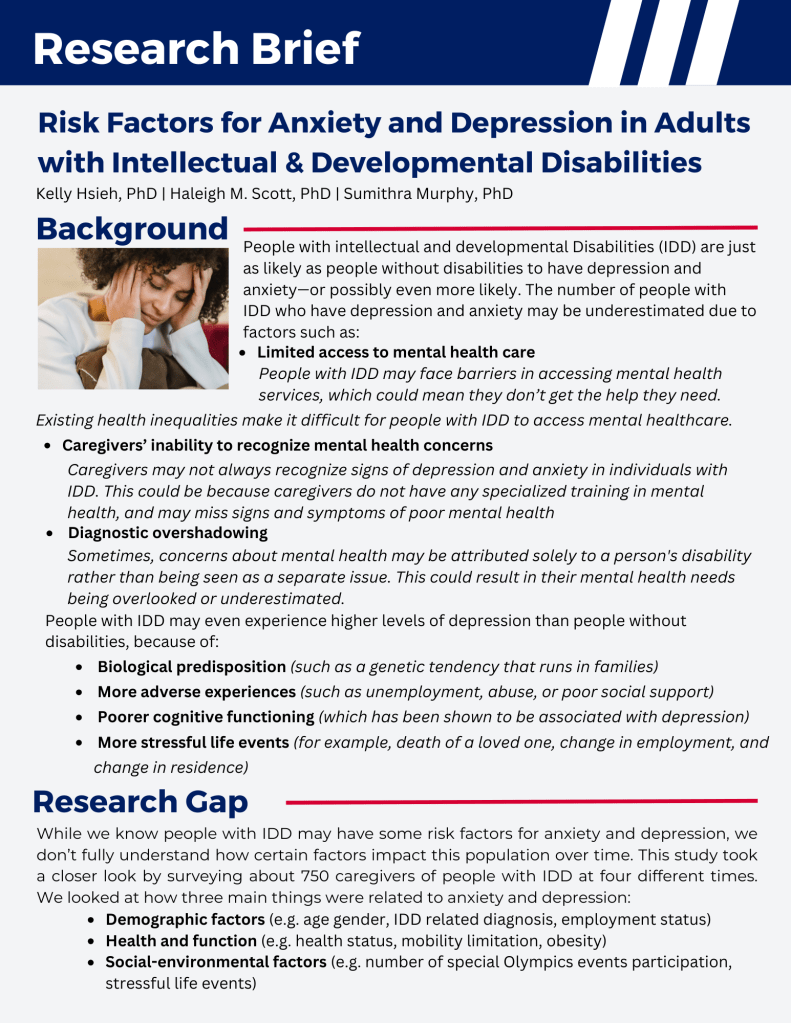
Research Brief: Risk Factors for Anxiety and Depression in Adults with Intellectual & Developmental Disabilities
The number of people with IDD who have depression and anxiety may be underestimated. Dr. Kelly Hsieh and colleagues studied the risk factors for anxiety and depression in a survey of caregivers of people with IDD. Find out more in this research brief.
This video research brief covers the 2021 article Lulinski, A. & Heller, T. (2021) Community capacity to provide mental/behavioral health services for individuals with intellectual and developmental disabilities Transitioning from state operated developmental centers. Intellectual and Developmental Disabilities, 59 (3) 224–238.

Video: Trauma Informed Care for People with Intellectual and Developmental Disabilities
This video gives a brief introduction to trauma informed care the the following learning objectives:
- Define trauma informed care
- Identify why people with intellectual and developmental disabilities are at higher risk for trauma
- Recognize the effects of trauma on people’s behavior, lives, and wellbeing
- Identify the 6 Principles of a Trauma Informed Approach, as outlined by the Substance Abuse and Mental Health Service Administration (SAMHSA)
 Illinois Dual Diagnosis Training Initiative