
Community Capacity in Illinois
Navigating the landscape of services for individuals with a dual diagnosis of intellectual and developmental disabilities and mental health conditions can be challenging. Illinois offers a range of specialized resources designed to meet the unique needs of this population. Below are some resources describe the current landscape of services and the service system in Illinois for people with a dual diagnosis.

As part of a larger project, the Division of Developmental Disabilities tasked UIC with better understanding how the State may better support seven different groups of people with IDD with additional support needs. The intent of this evaluation was to better understand the supports necessarily to adequately support these groups and identify ways to expand the capacity of the State to serve these groups of people with DD. The groups identified include 1) people with complex medical support needs; 2) people who are insulin-dependent diabetics; 3) people with high behavioral support needs; 4) people with autism spectrum disorder or other sensory support needs; 5) people who are deaf/Deaf/hard-of-hearing; 6) people who are blind/have a visual impairment; and 7) people who have physical accessibility support needs. Both individual interviews and an online survey of community providers were conducted. Recommendations to support each group are provided to the Division.

Community Capacity Report Webinar
This archived webinar covers the Illinois Community Capacity Report described above.
Community Capacity to Provide Mental/Behavioral Health Services
This video research brief covers the 2021 article Lulinski, A. & Heller, T. (2021) Community capacity to provide mental/behavioral health services for individuals with intellectual and developmental disabilities Transitioning from state operated developmental centers. Intellectual and Developmental Disabilities, 59 (3) 224–238. The full article is available here.

This webinar from the Illinois Division of Developmental Disabilities in September 2022 discusses ways to support people with a dual diagnosis. Speakers included Randa Abdelrahim from the Institute on Disability and Human Development; Charlene Bennett, the CEO of a DD-provider agency in Illinois (Individual Advocacy Group, IAG); Curtis Harris, a self-advocate with a dual diagnosis; and Joy Decker, then Deputy Director of Community Services within the Illinois Division of Developmental Disabilities. The webinar discussed the project that this website grew out of (Randa, National Training Initiative). Charlene discussed how IAG supports people with dual diagnoses and more significant support needs through interdisciplinary collaboration; strategies to mitigate risk; dignity of risk assessment; ongoing team meetings; and person-centeredness. Curtis talked about his diagnoses, coping strategies, his services, and his experiences and their impacts. Joy talked about services offered through the waiver program (behavior intervention and treatment; counseling and psychotherapy). Additionally, Joy provided an overview of Support Services Teams (SSTs) and Short-Term Stabilization Homes (SSH). Lastly, Joy discussed the Children’s Behavioral Health Transformation Initiative.
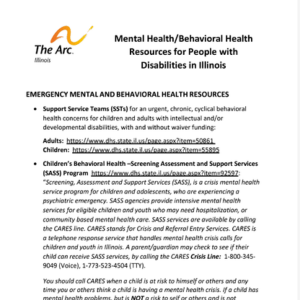
Mental Health/Behavioral Health Resources for People with Disabilities in Illinois
This document from the Arc of Illinois provides an overview of mental and behavioral health resources for people with disabilities in Illinois, focusing on both emergency and non-emergency situations. It covers:
- Emergency Mental and Behavioral Health Resources
- Non-Emergency Mental Health Resources
- Information on accessing mental and behavioral health services through various insurance plans, including Medicaid
- Guidance for those in Medicaid Managed Care, including resources for both adults and youth
- Information for individuals receiving Medicaid Home and Community-Based Waiver Services
- Additional Helpful Resources
 Illinois Dual Diagnosis Training Initiative