
Assessment and Diagnostic Tools
Screening Adults with IDD for Common Mental Health Disorders
Adults with IDD are at greater risk of developing psychiatric disorders than those without IDD (Lineberry et al., 2023). Diagnostic overshadowing refers to the tendency of service providers to misattribute symptoms of psychiatric disorder to IDD, which means that psychiatric symptoms go unrecognized and remain untreated with negative consequences for the person’s health and well-being (Dell’Armo & Tassé, 2024). Below, we present freely available screening instruments that can be used to determine whether a person is experiencing emotional distress at levels indicating the need for referral to a mental health professional. These are not diagnostic instruments, and diagnostic assessment should only be done by a trained mental health clinician. At the bottom of the page are links to information on additional behavioral health assessments for people with IDD, many of which are proprietary and/or require training to administer.
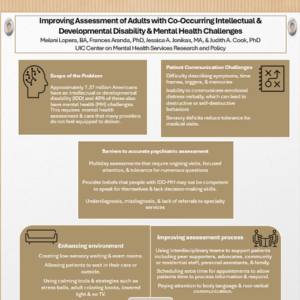
This infographic from the UIC Center on Mental Health Services Research and Policy covers scope of the problem, patient communication challenges, barriers to accurate psychiatric assessment, and emerging best practices for assessing adults with co-occurring intellectual & developmental disability and mental health challenges.
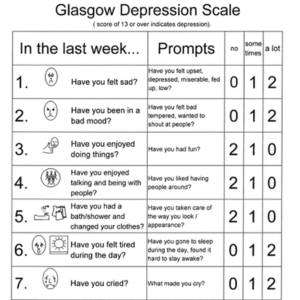
The Glasgow Depression Scale is a brief 20-item self-report depression tool for people with IDD, which also has a 16-item carer supplement form. The full scale is available in the appendix of this article (Cuthill et al., 2003).
This scale has been adapted with illustrations for use with people with intellectual and developmental disabilities.

The Glasgow Anxiety Scale is a brief 27-item self-report tool to assess symptoms of anxiety among people with IDD. It does not have an carer informant version. The full scale is available in the appendix of this article (Mindham & Espie, 2003).
This scale has been adapted with illustrations for use with people with intellectual and developmental disabilities.
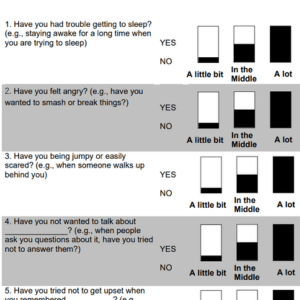
Impact of Event Scale–Intellectual Disabilities (IES-IDs)
The Impact of Event Scale–Intellectual Disabilities (IES-IDs) is a 22-item scale that measures symptoms of post-traumatic stress disorder (PTSD) in people with intellectual disabilities (Hall et al., 2014). The full scale is available via this link.

Wayne State University: Assessing Mental Health Concerns in Adults with Intellectual Disabilities
Wayne State University compiled a list of assessment tools available for people with intellectual and developmental disabilities.
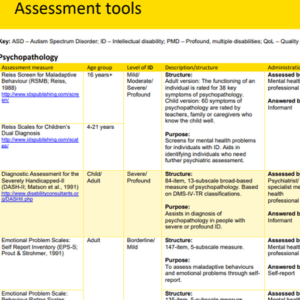
UNSW Sydney Assessment Scales for People with Intellectual and Developmental Disabilities
UNSW Syndney compiled a list of assessment tools available for people with intellectual and developmental disabilities.
References
Cuthill, F. M., Espie, C. A., & Cooper, S. A. (2003). Development and psychometric properties of the Glasgow Depression Scale for people with a Learning Disability: Individual and carer supplement versions. The British Journal of Psychiatry, 182(4), 347-353. https://doi.org/10.1192/bjp.182.4.347
Dell’Armo, K., & Tassé, M. J. (2024). Diagnostic overshadowing of psychological disorders in people with intellectual disability: A systematic review. American Journal on Intellectual and Developmental Disabilities, 129(2), 116-134. https://doi.org/10.1352/1944-7558-129.2.116
Hall, J. C., Jobson, L., & Langdon, P. E. (2014). Measuring symptoms of post-traumatic stress disorder in people with intellectual disabilities: The development and psychometric properties of the Impact of Event Scale-Intellectual Disabilities (IES-IDs). The British Journal of Clinical Psychology, 53(3), 315-332. https://doi.org/10.1111/bjc.12048
Lineberry, S., Bogenschutz, M., Broda, M., Dinora, P., Prohn, S., & West, A. (2023). Co-Occurring mental illness and behavioral support needs in adults with intellectual and developmental disabilities. Community Mental Health Journal, 59(6), 1119-1128. https://doi.org/10.1007/s10597-023-01091-4
Mindham, J., & Espie, C. A. (2003). Glasgow Anxiety Scale for people with an Intellectual Disability (GAS-ID): Development and psychometric properties of a new measure for use with people with mild intellectual disability. Journal of Intellectual Disability Research, 47(1), 22-30. https://doi.org/10.1046/j.1365-2788.2003.00457.x
 BETA Illinois Dual Diagnosis Training Initiative